GRE Information and FAQ
Click on the following links for answers to commonly asked questions about the GRE.
- What does the GRE measure?
- How important is the GRE, and how is it used by admissions committees?
- How long is the GRE?
- How many questions are on the GRE?
- How is the GRE scored?
- When is the GRE given?
- Where is the GRE given?
- How much does the GRE cost?
- How soon will I get my GRE scores?
- Can I cancel my GRE score?
- How many times should I take the GRE?
What does the GRE measure?
The GRE is a computer-adaptive aptitude test designed to measure a student’s ability to succeed in graduate school. It consists of three sections:
- Analytical writing: designed to measure a student’s ability to think critically and express complex ideas in a clear and organized fashion
- Verbal reasoning: arguably the most challenging GRE section; designed to test a student’s vocabulary, reading comprehension, and analogical reasoning
- Quantitative reasoning: also known as the math section of the GRE; covers basic arithmetic, algebra, geometry, and data (or chart) analysis.
How important is the GRE, and how is it used by admissions committees?
Most schools require a GRE score before considering admission, though how a school weights a GRE score in the overall admissions decision is highly individualized. Some schools require a minimum overall score, while other graduate programs may only factor in one of your section scores. For example, math or engineering graduate programs may not care about your verbal score, and English graduate programs may not pay attention to your GRE math score. Before taking the test, however, make sure you contact the programs to which you will be applying to find out what their specific GRE requirements are for admission.
If you like this material, you’ll love the course!

This interactive, comprehensive self-study course presents the equivalent of over 600 pages of printed material, including hundreds of GRE examples, problems, videos, and feedback from GRE experts to your questions. All for only $19.95! Click the link above for a tour of the course.
Similar online programs cost upwards of $699! With more than $680 in savings and quality that can’t be matched, Nova Press is unquestionably the smartest option in GRE prep.
Course Features:
- Ask Questions! Our experts monitor the course to answer your questions in real-time during business hours or within 24 hours outside of business hours.
- Highly Interactive: You can take notes, view detailed explanations of solutions, and more!
- Videos: More than 500 videos guide you through the concepts and examples.
- Versatile: Access the course from any computer at any time.
- Statistics: Your performance on the exercises is saved, and you may review your performance and check solutions at any time.
- Guarantee: If, at the end of the course, you do not feel sufficiently prepared for the test, you may repeat the course for free — with full access to our experts.
Reviews:
Love this class. I went from not being able to answer any questions to understanding and solving most of the problems. It is still a work in progress, but I am feeling much more prepared for the test now! Great job! – Ana Maria Moreno
This course is very helpful. The instructor reads a few basic principles of mathematics, and then solves a block of questions which require that particular understanding. You can pause each video before the instructor begins and try to solve it on your own and then compare your method and answer to the narrated approach and correct solution. – Vincent Stowell
How long is the GRE?
The GRE is a 3-hour and 10-minute test, though ETS also includes an extra “research” or “experimental” section. This additional math or verbal section will not affect your score but will lengthen the time you spend in the testing center. Here is the time-per-section breakdown: Analytical writing (30 minutes), Verbal reasoning (47 minutes), Quantitative reasoning (47 minutes).
How many questions are on the GRE?
The analytical writing section of the GRE consists of one essay, involving properly supporting an opinion on an issue. The verbal reasoning section consists of 28 multiple-choice questions. The quantitative reasoning section consists of 27 multiple-choice questions, for a total of 55 multiple-choice questions and 1 essay on the GRE.
Are you ready for the math section of the GRE?
With our comprehensive book, you can be sure!
Although the GRE math section is difficult, it is very learnable. GRE Math Prep Course presents a thorough analysis of GRE math and introduces numerous analytic techniques that will help you immensely, not only on the GRE but in graduate school as well.
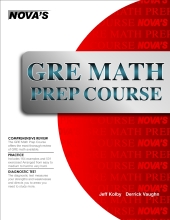
- Comprehensive Review: Twenty-three chapters provide comprehensive review of GRE math.
- Practice: Includes 164 examples and more than 600 exercises! Arranged from easy to medium to hard to very hard.
- Diagnostic Test: The diagnostic test measures your strengths and weaknesses and directs you to areas you need to study more.
- Dual Exercises: These are pairs of similar GRE problems in which only one property is different. They give you insight into how GRE problems are constructed.
- Performance: If your target is a top-tier score, this is the book!
Testimonial:
I have tried other brands to help increase my GRE math score, but I found this book by far to be the best. Some of the questions are indeed harder than what you will see on the test which is a good thing as I studied from this book for 4 weeks and my quantitative score improved drastically. After the 4 weeks, I returned to look at some questions in other math prep books and I could do them all, even the difficult ones quiet easily.
You need a good understanding of math concepts, and this book is not for beginners. It will definitely get you into the top bracket quiet easily.
Pages: 528
ISBN: 1889057952
Purchase GRE Math Prep Course (printed book) ($29.95) (Free shipping within the United States.) (We do not ship outside of the United States.)
Also available as an Amazon Kindle eBook:
GRE Math Prep Course – Kindle eBook

How is the GRE scored?
The three major parts of the test are scored independently. You will receive a verbal score, a math score, and a writing score. The verbal and math scores range from 130 to 170, in 1-point increments. The writing score is on a scale from 0 to 6. In addition to the scaled score, you will be assigned a percentile ranking, which gives the percentage of students with scores below yours.
When is the GRE given?
The test is given year-round. You can take the test during normal business hours in the first three weeks of each month. Weekends are also available in many locations. You can register as late as the day before the test, but spaces do fill up, so it’s best to register at least a couple of weeks before you plan to take the test.
Where is the GRE given?
The GRE is administered at testing centers all over. For one closest to you or to register, visit the ETS website.
How soon will I get my GRE scores?
Your will receive your scores on the quantitative and verbal reasoning sections before you even leave the testing center. After completing all sections of the exam as well as any research sections, your score will be visible on your computer screen. It takes another month on average to receive your score on the analytical writing section, and you will receive it in the mail.
Can I cancel my GRE score?
Yes. After you have finished the GRE and before your score is revealed, you can choose to cancel the test. Make note that if you choose to cancel, you will not find out what score you would have gotten. Your score cancellation will not affect your permanent record. No refund will be given. To retake the test, you will need to pay the registration fee again and re-register for a date at least a month from the last time you took the test.
How many times should I take the GRE?
It is recommended that you prepare thoroughly and take the GRE once to get your best score. You can re-take the test, but many schools will average your scores from each time you took it, as opposed to taking only your highest score. Contact each graduate program to which you intend to apply to find out its policy.
